
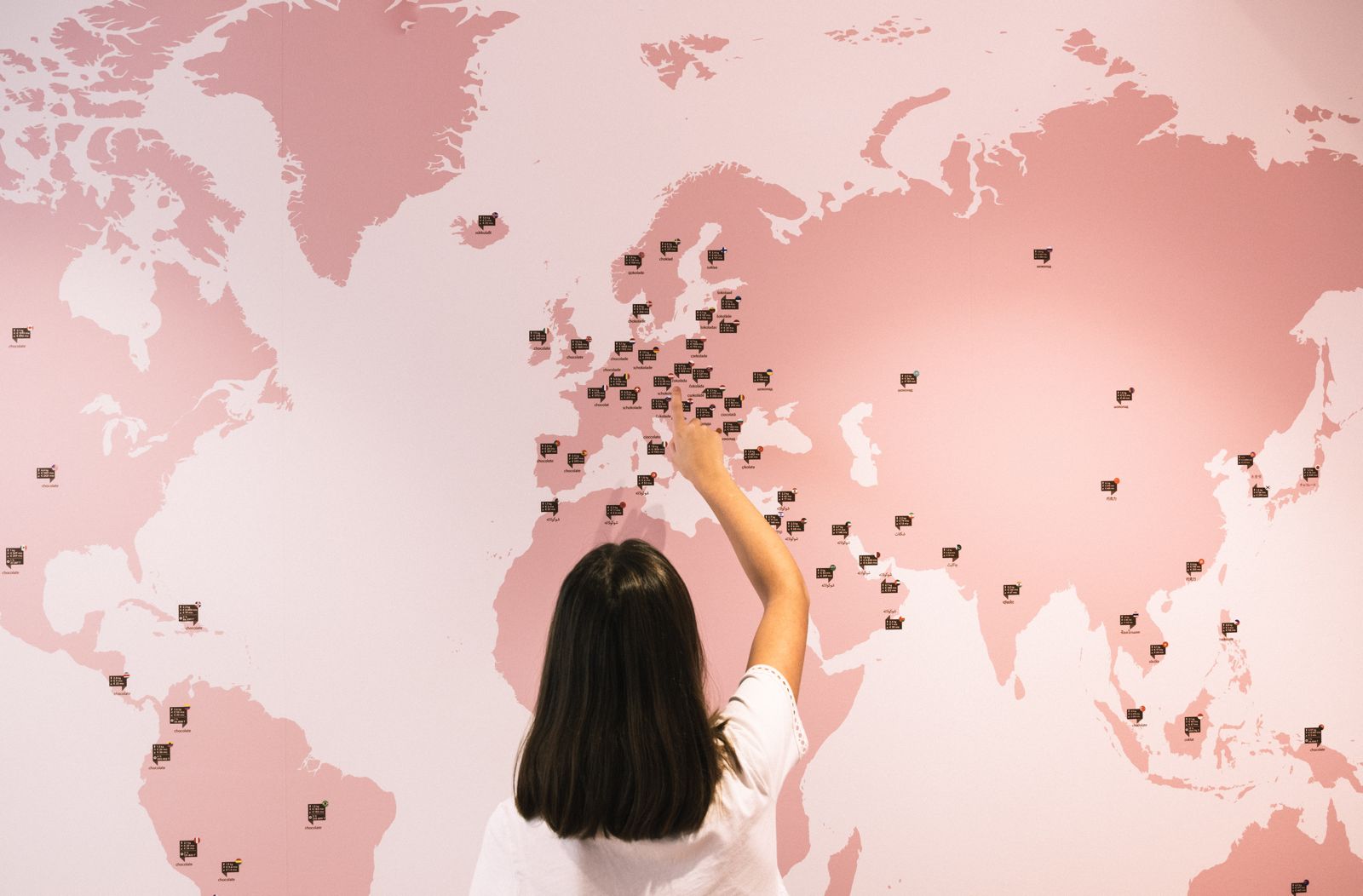
White, dark or ruby chocolate – those are terms you already know well. Behind them, however, lies an entire empire of words, processes, varieties, objects and people without which the world of chocolate cannot be understood. What exactly is conching? Why is chocolate tempered? What separates criollo from forastero? Where does that pale film on the chocolate forgotten in your drawer come from, and what on earth is a moustache cup?
At the Chocolate Museum Zagreb we hear these questions every single day, so we have expanded our glossary into the most complete guide to the chocolate world we could put together. It is arranged alphabetically, like an encyclopaedia, and covers everything – from the botany of the cacao tree and the chemistry of cocoa butter, through historical figures, artefacts and landmark inventions, to industrial giants, Croatian producers and the terms you will meet on the labels of the world’s finest chocolate.
Use Ctrl + F (or Cmd + F on a Mac) to jump to a particular term, or simply read it through – you may be surprised how much you did not know about your favourite sweet.
A
Academy of Chocolate Awards – The Academy of Chocolate is an independent body that promotes real chocolate through cooperation with producers and retailers, raising awareness of the role chocolate plays in the overall wellbeing of society. It encourages sustainable and ethical production and provides educational opportunities. Its prestigious awards were launched in 2005 and aim to identify, recognise and present the world’s most talented chocolate makers and their finest chocolates. The first gold medal ever won by a Croatian chocolate at this competition went to Marinko Biškić’s Nadalina.
Aeration – A process in which gas (usually nitrogen or carbon dioxide) is injected into liquid chocolate under pressure, after which the pressure is rapidly released. The resulting fine bubbles give the chocolate its distinctive porous structure and melting sensation. Every “aerated” chocolate works on this principle.
Alkalisation (dutching) – Treating cocoa mass or cocoa powder with alkaline salts to reduce acidity and bitterness while deepening the colour. The process was developed by Coenraad Van Houten, and chocolate made this way is known as “Dutch process” chocolate. Alkalised cocoa dissolves better in liquid but loses part of its polyphenols.
Amelonado – The most widespread subgroup of forastero, recognisable by its smooth, melon-shaped pods. Originating in the upper Amazon basin, it now forms the backbone of West African plantations and the bulk of world cocoa production.
Anandamide – A compound found in cacao that acts in the brain much like an endocannabinoid, earning it the popular nickname “the bliss molecule”. It occurs in tiny quantities, so its real effect on mood is far more modest than the headlines suggest.
Arriba Nacional – A rare cacao variety grown exclusively in Ecuador. Considered one of the finest and oldest varieties, it is the basis for some of the world’s most highly regarded chocolates (such as Ecuador’s To’ak and Croatia’s Taman). It is known for pronounced floral and nutty aromas.
Aztecs – The last and best known of the ancient Mexican civilisations, ruling a vast empire in southern Mexico in the 15th and 16th centuries. Cacao beans served them as currency, and the xocoatl drink held the status of a ritual and elite beverage.
B
Bajadera – A cult Croatian confection made by Kraš: a nougat praline with hazelnuts and almonds, neither baked nor tempered. It long ago outgrew the status of a sweet and became part of Croatia’s festive identity.
Barry Callebaut – Headquartered in Switzerland, the group was created in 1996 through the merger of Belgian chocolate producer Callebaut and French producer Cacao Barry. Today the Barry Callebaut Group is the largest chocolate and chocolate products manufacturer in the world, and its couverture underpins the work of most chocolatiers worldwide.
Bean-to-bar chocolate – Chocolate made by a single producer all the way from the cocoa bean to the finished product, without using ready-made couverture. It implies control over sourcing, roasting, winnowing, grinding, conching and tempering.
Belanda/Kerafat – Light-coloured hybrid cocoa beans grown in Papua, the easternmost part of Indonesia. These are rare beans used by the sustainability-focused company Original Beans.
Belcolade – A Belgian chocolate brand based in Erembodegem, made in the traditional way from the finest ingredients from around the world. It is part of the international Puratos group and one of the largest chocolate makers in the world.
Beniano – A wild cacao growing in Bolivia. It has relatively small pods whose beans are sweet, with nutty and fruity flavours.
Blended chocolate – Chocolate made from a mixture of different cacao varieties or from beans of different origins. Its aim is consistency and a balanced profile, in contrast to the single-origin approach.
Bloom – The whitish layer on chocolate, which arises for two reasons. Sugar bloom occurs when the surface of the chocolate becomes damp: moisture dissolves the sugar, and once the chocolate dries, sugar crystals remain on the surface. Fat bloom occurs when fat migrates out of the chocolate to the surface, triggered by storage in warm conditions or by large temperature swings. Chocolate with a white layer is not necessarily spoiled, but its texture has changed.
Broma process – A method in which cocoa mass is hung in a warm room so that cocoa butter separates under gravity. It preceded modern hydraulic presses and was an important step in the industrial production of cocoa powder.
Brownie – A dense American cake with an intense chocolate flavour, a moist centre and a thin glossy crust. It appears in recipes from the end of the 19th century and is today one of the world’s most recognisable chocolate desserts.
C
Cacao Barry – A French house founded in 1842 by Charles Barry, who travelled to Africa in search of cocoa beans. Today part of the Barry Callebaut group, it is known for couvertures aimed at professional pastry chefs.
Cadmium – A heavy metal that the cacao tree absorbs from the soil, particularly on the volcanic soils of South America. The European Union sets maximum permitted cadmium levels in chocolate and cocoa products, with stricter limits for products of higher cocoa content. Some makers therefore deliberately blend beans of different origins.
Callebaut – A Belgian chocolate producer that began making chocolate in 1911 in Wieze. Its couvertures are a standard of Belgian confectionery, and many small chocolatiers – Croatian ones included – work with them.
Caramel – The product of thermal breakdown of sugar and a frequent filling in chocolate bonbons. Combined with cream and salt, it has become one of the most popular modern chocolate flavours.
Cargill – An American privately held global food corporation headquartered in Minnetonka, Minnesota, founded in 1865. Among other things it produces and distributes chocolate, making it one of the largest chocolate makers in the world.
CBE (Cocoa Butter Equivalent) – Vegetable fats (from shea, palm or illipe, for example) that behave similarly to cocoa butter. European rules allow them to make up no more than 5 % of the finished product and require them to be declared. Fine chocolate contains none.
CCN-51 – A high-yielding cacao clone developed in Ecuador in the mid-20th century. Disease-resistant and several times more productive than traditional varieties, it remains controversial in the fine chocolate world because of its neutral to astringent flavour. It is the perfect illustration of the tension between yield and aroma.
Cell-cultured cocoa – An experimental approach in which cacao cells are grown in bioreactors rather than on plantations, aiming at production independent of climate and deforestation. For now it is an expensive, early-stage technology with no meaningful market share.
Ceremonial cacao – Minimally processed cocoa mass from which the cocoa butter is not removed, prepared as a thick drink in a ritual or meditative setting. It draws on Mesoamerican tradition, though in its present form it is largely a modern Western interpretation.
Chocolate – Under European rules, a product made from cocoa products and sugar containing at least 35 % total dry cocoa solids, of which at least 18 % cocoa butter and at least 14 % fat-free dry cocoa solids.
Chocolate house – A social venue of the 17th and 18th centuries, above all in London, where politics and trade were debated and gambling took place over a cup of hot chocolate. Several of them later grew into respected English clubs and financial institutions.
Chocolate maker – A person or company that produces chocolate products from the cocoa bean itself, from bean to couverture. Not to be confused with a chocolatier, who works with finished chocolate.
Chocolate pot (chocolatière) – The vessel from which a chocolate drink is served into cups. It resembles a teapot, differing in its short, wide spout and a frequently built-in molinet.
Chocolatier – A person who produces chocolates and chocolate confectionery (such as pralines) from previously made chocolate, that is, from chocolate couverture.
Chozen – A Croatian brand of chocolate bonbons founded by Dražen Zeljković. It is known for original flavour combinations, hand-painted shells and thoroughly modern technique.
Chuao – A village in northern Venezuela where authentic cacao varieties such as criollo have been grown since 1591. Chuao beans, alongside Porcelana, are considered among the finest and most expensive in Venezuela.
Climate change – The cacao tree needs a narrow range of temperature, humidity and shade, which makes it acutely vulnerable to drought, heatwaves and events such as El Niño. The combination of extreme weather and disease in West Africa directly triggered the cocoa price crisis, and projections warn of shrinking suitable growing areas by mid-century.
Cocoa butter – Cocoa butter, also known as theobroma oil, is a pale yellow edible fat extracted from the cocoa bean. It is used to make chocolate as well as certain fats, cosmetics and pharmaceutical preparations. It has its own taste and aroma, and its melting point sits just below human body temperature.
Cocoa content – The percentage of cocoa material in chocolate, including both the dry solids (cocoa powder) and the fat (cocoa butter). A high percentage does not automatically mean higher quality: it speaks of quantity, not of the character of the bean or the skill of the maker.
Cocoa-free chocolate – A new category of products that achieve the taste and texture of chocolate without a single cocoa bean, usually from fermented oats, sunflower seeds, carob or grape seeds. It has been driven by the surge in cocoa prices and by sustainability concerns; under European rules such products may not be called chocolate.
Cocoa liquor – A solid or liquid mass obtained by grinding cocoa beans with heat. It consists of 100 % cocoa (dry cocoa solids and cocoa butter) and can therefore be regarded as pure chocolate. It contains neither sugar nor alcohol – despite the name – and can be tasted at the Chocolate Museum Zagreb.
Cocoa pod – The fruit of the cacao tree, 15 to 30 cm long, yellow, orange or crimson. It holds 30 to 50 beans wrapped in white, sweet-sour pulp.
Cocoa prices – Cocoa is traded on the ICE exchanges in London and New York. After a record deficit in the 2023/24 season, the largest in more than sixty years, prices broke through USD 12,000 per tonne at the end of 2024 and pushed up the cost of virtually every chocolate on the shelf. Recovering West African harvests brought two consecutive surplus seasons, so through 2025 and 2026 prices corrected sharply, to somewhere between roughly USD 4,000 and 6,000 per tonne. Volatility, however, has remained the rule rather than the exception.
Cocoa pulp – The white, juicy tissue around the beans, tasting somewhere between lychee, mango and lime. Its sugars drive fermentation, and it is increasingly used in its own right – as juice, vinegar or a natural sweetener in chocolate.
Coconut cup – Cups made from coconut shell were very popular in Western Europe during the 15th and 16th centuries. They build on the tradition of wooden cups and goblets, and the popularity of coconut shell stems from the curious belief that such cups could neutralise poison in a drink.
Conching – The final stage in making chocolate mass, during which a series of inseparable physical and chemical processes take place simultaneously. It is carried out by mixing and grinding the chocolate mass in an (originally) granite vessel shaped like a shell – hence the name – at temperatures above 50 °C for several hours. Rodolphe Lindt discovered the process by chance in 1879, turning chocolate from gritty into velvety.
Cortés, Hernán (1485–1547) – The Spanish conquistador, explorer, adventurer and coloniser responsible for the expansion of cacao into Europe. After the conquest of Cuba he moved inland in Mexico, founded Veracruz and entered Tenochtitlán, where he captured emperor Montezuma II. From the Aztecs he learned how the cacao drink was prepared, which then, with adaptations, came into use at courts across Europe.
Couverture – High-quality chocolate with an increased cocoa butter content (at least 31–32 %, often up to 39 %). Its greater fluidity makes it ideal for enrobing, moulding bonbons and creating decorations, and it is the professional confectioner’s standard.
Craft chocolate – Chocolate made from raw cocoa beans in fully controlled conditions. It is produced in small batches, with a strong emphasis on quality.
Criollo – One of the three most widespread cacao varieties. Native to Central and South America, it is often cited as the most prized type of cacao. Disease-prone and low-yielding, it delivers an exceptionally fine aroma with nutty and floral notes.
Cru – A term borrowed from winemaking, denoting chocolate from a precisely defined, limited geographical unit – a plantation, valley or village. Grand cru implies exceptional quality from such a limited origin.
Crystallisation – The process by which cocoa butter solidifies. It can form six different crystal types, but only Form V delivers gloss, a firm snap and stability. Controlling this process is what we call tempering.
D
Dark chocolate – Made of cocoa powder (dry solids), cocoa butter, sugar and an emulsifier. It must contain a minimum of 35 % cocoa solids.
Dark milk chocolate – A variant of milk chocolate with a high cocoa content, usually above 40 %.
Direct trade – A model in which the chocolate maker buys beans directly from growers or cooperatives, without intermediaries and above the exchange price. It is not a formal certification like Fairtrade, but it often delivers greater transparency and better income for farmers.
Dorina – Kraš’s milk chocolate, launched in the 1960s and now one of Croatia’s most recognisable bars.
Drying – The stage after fermentation in which the moisture content of the beans falls from around 60 % to about 7 %. It usually takes place in the sun over one to two weeks, with constant turning. Drying too slowly invites mould; drying too fast locks acidity into the bean.
Dubai chocolate – A bar with a thick milk chocolate shell and a filling of pistachio cream, tahini and crisp kataifi pastry. It was created by Sarah Hamouda at Dubai’s Fix Dessert Chocolatier under the name “Can’t Get Knafeh of It”, and after a viral TikTok video in 2023 and 2024 it became a global phenomenon, spawning hundreds of imitations and noticeably lifting world demand for pistachios.
E
Easter egg – A hollow chocolate figure formed in polycarbonate moulds by joining two halves. The tradition dates from 19th-century Europe, and making one demands flawless tempering – otherwise the egg simply will not release from the mould.
Ecuador – The home of Arriba Nacional and one of the world’s most important sources of fine flavour cacao. It is also an increasingly significant producer of finished single-origin chocolate.
Emulsifiers – Substances that reduce surface tension. In chocolate production they help bind dry cocoa solids, sugar and milk with cocoa butter. Their use has increased as a way of reducing the cocoa butter content, which lowers production costs – sometimes at the expense of quality.
Enrobing – An industrial process in which a centre (wafer, biscuit, nougat) passes through a curtain of liquid chocolate and is then cooled in a tunnel, producing an even chocolate coating.
EUDR (EU Deforestation Regulation) – European legislation in force since 2023 requiring that cocoa, coffee, palm oil, soy, rubber, wood and beef placed on the EU market do not originate from land deforested after 2020. It applies to large and medium companies from 30 December 2026 and to micro and small operators from 30 June 2027. In practice it demands geolocation of every plot a bean comes from, an enormous logistical challenge for a sector with millions of smallholders.
F
Fairtrade – Fair trade is the name for a form of supervised trade in which the prices paid to producers are usually higher than world market prices. The aim is to give producers a larger and more reliable income than conventional trade provides. Although the idea behind the model is a positive one, it is nonetheless accompanied by controversy and criticism.
Fermentation – The first and decisive step in creating chocolate flavour. Beans rest together with their pulp in boxes or under banana leaves for three to seven days, during which yeasts and bacteria break down sugars, the temperature rises, the germ dies and flavour precursors develop. No amount of roasting can rescue a badly fermented bean.
Fine flavour cacao – Cacao classified by the ICCO as “fine or flavour” on account of its pronounced aromatic profile. It accounts for only a few per cent of world production, as opposed to bulk cocoa.
Flavanols – A group of cocoa polyphenols credited with most of dark chocolate’s health benefits, particularly the favourable effect on blood vessels. They are sensitive to alkalisation and prolonged roasting.
Flavour wheel – A sensory tool that organises chocolate aromas and tastes into families (fruity, floral, nutty, spicy, earthy, smoky, fermented). It is used in professional tastings and competitions so that tasters speak a common language.
Forastero – One of the three most widespread cacao varieties. It is highly resistant and has spread everywhere cacao grows, accounting for up to 90 % of world production. It is generally considered less refined than the others, though some of its subvarieties are among the most sought-after.
Form V – The fifth of six crystal forms of cocoa butter and the only desirable one in finished chocolate. It gives a glossy surface, a sharp snap, resistance to bloom and a melting point of around 34 °C – just below body temperature.
Fry’s – Fry’s of Bristol is the English chocolate producer that in 1847 developed the first chocolate bar, recombining cocoa butter with cocoa mass and sugar. With it, chocolate moved from the cup into the hand.
G
Ganache – A mixture of chocolate and cream used to fill truffles, chocolate bonbons and other confections. The ratio of chocolate to liquid decides whether it becomes a soft cream, a firm filling or a glaze.
Gianduja – An Italian paste of chocolate and finely ground hazelnuts, born in Turin when Napoleon’s continental blockade made cocoa scarce and local hazelnuts filled the gap. It is the ancestor of every modern hazelnut spread.
Gold chocolate – Caramelised white chocolate of a golden colour, with notes of caramel, biscuit and salt. It is made by heating white chocolate slowly until its milk sugars and proteins caramelise.
H
Hershey, Milton S. – An American chocolatier, entrepreneur and philanthropist who founded the Hershey Chocolate Company in 1894. Alongside the factory he built a utopian town for his workers, complete with its own bank, public transport, hospital, schools, zoo, amusement park and even an orphanage. He produced milk on his own Pennsylvania farms and grew sugar in Cuba, where he raised a second “Hershey town” with its own railway, still running today. His chocolate was never renowned as world-class, but he was a brilliant organiser and marketing innovator – and the inspiration for the character of Willy Wonka.
Hispaniola – A type of cocoa powder made from beans from the Dominican Republic, on the Caribbean island of Hispaniola.
Hot chocolate – A drink made from melted chocolate or cocoa powder in milk or water. The thick European version is made from real chocolate, while the American tradition is thinner and based on cocoa powder.
I
Inclusions – Solid additions stirred into chocolate mass before moulding: nuts, freeze-dried fruit, biscuit, salt, spices, nibs. They affect flavour, texture and shelf life.
International Chocolate Awards – An independent competition recognising excellence in fine chocolate making and in products made from fine chocolate. As the only fully independent international fine chocolate competition in the world, it supports companies, small artisans and the farmers who grow superior cacao.
International Cocoa Organization (ICCO) – An intergovernmental organisation founded in 1973 under the auspices of the United Nations, operating within successive international cocoa agreements. It has 51 member countries – 22 cocoa exporters and 29 importers – which together represent 92 % of world cocoa exports and 80 % of world cocoa imports.
Ivory Coast – The world’s largest cocoa producer, accounting for roughly 40 % of global output. It is also the focal point of debates about child labour, deforestation and low farm-gate prices.
K
Kandit – A confectionery producer from Osijek making chocolate, sweets and cream products. The “First Osijek Candy Factory Kaiser and Stark” was founded in 1920 and soon bought a licence to produce chocolate from the well-known Viennese factory Pischinger.
Kraš – The oldest and largest chocolate maker in this part of Europe. Founded in 1911 under the name Union, it took the name Kraš after the Second World War, after the national hero Josip Kraš, merging with a series of smaller Zagreb factories and workshops. It is known for brands such as Bajadera, Griotte and Životinjsko carstvo.
L
Lecithin – An emulsifier used to combine water and oil. Biochemically it belongs to the phosphatidylcholines, a type of phospholipid, and is obtained from eggs or soy. It is nutritious and non-toxic, and in chocolate it is used at a very low dosage, usually 0.3–0.5 %.
Lindt, Rodolphe – A Swiss chocolate maker, chocolatier and inventor. He founded the Swiss chocolate house Lindt and discovered the conching process, invented a pressing machine and devised other methods for improving chocolate quality.
M
Mars – The company founded by Franklin Clarence Mars, which under his son Forest became a global giant in chocolate and confectionery with products such as Bounty, Twix, Mars, Snickers and Milky Way, the chewing gums Orbit and Hubba Bubba, and M&M’s and Skittles. Today it is the third-largest American company that is entirely, 100 % privately owned by the Mars family.
Mass balance – An accounting model for certified cocoa in which certified and uncertified beans are mixed during processing and only the volumes are tracked. It is the opposite of segregation, where certified beans stay physically separate all the way to the finished product. A logo on the wrapper therefore does not necessarily mean those particular beans were certified.
Maya – A group of related Mesoamerican peoples who cultivated and drank cacao for centuries before the Aztecs. They prepared it hot and foamy by pouring it from vessel to vessel, and cacao held a central place in religious rites, weddings and funerals.
Melanger – A machine with granite rollers that grinds and conches cocoa mass at the same time. It is indispensable in small bean-to-bar workshops because it combines two key production stages in a single device.
Mendiant – A French classic: a thin disc of tempered chocolate scattered with nuts and dried fruit. Traditionally the four toppings symbolised the four mendicant religious orders.
Metate – Probably the most important and longest-serving tool in chocolate production, used to grind cocoa beans into as fine a powder as possible. It generally consists of two stone elements – a massive base (often a volcanic stone tripod) and a roller. It predates the discovery of cacao itself, as maize was ground on it too.
Micron – The unit used to describe particle size in chocolate. Particles must be smaller than roughly 20–30 microns for the tongue not to perceive them as grittiness. Achieving that fineness is the job of refining.
Milk chocolate – A solid chocolate confection containing cocoa, sugar and milk powder. The most popular form of chocolate in many countries, it was originally sold only as a bar but is now available in a range of other forms.
Molinet – A simpler version of the molinillo, used in France and forming part of the chocolate pot from which cocoa was served.
Molinillo – A wooden whisk used to raise foam on chocolate drinks. It is first recorded in the 16th century in Central America.
Moustache cup – A cup designed specifically for moustachioed men. It has a porcelain guard on the inside that protected a wax-styled moustache from direct contact with heat and steam, with the drink sipped through an opening in the guard. It was invented in 1860 by the Briton Harvey Adams.
N
Nadalina – A spice producer from Solin that since 2013 has become increasingly known for its chocolate, with a shop in Split. Behind the brand stands Marinko Biškić, Croatia’s first bean-to-bar maker, who works exclusively with dark chocolate and Dalmatian flavours such as carob, fig and lavender. His milk chocolate with Nicaraguan coffee won the first gold medal ever awarded to a Croatian chocolate at London’s Academy of Chocolate competition, while the version made with Cuban beans took bronze (Slatkopedija). Biškić also created the first playable chocolate gramophone record, and in 2015 set a Guinness record for the world’s largest chocolate, covering 102 square metres.
Nestlé – The largest food group in the world and the largest Swiss industrial chocolate producer. It was founded in 1866 by Henri Nestlé under the name “Farine Lactée Henri Nestlé S. A.” and took part in the creation of the first milk chocolate.
Nibs – Pieces of roasted cocoa bean with the husk removed. Crisp, bitter and intensely aromatic, they are the raw material for grinding into cocoa mass.
Nougat – A mass of sugar or honey, egg white and nuts (white nougat), or of caramelised sugar and hazelnuts ground into a paste (brown nougat). It is one of the oldest fillings in chocolate confectionery.
O
Olmecs – The oldest civilised people of Mexico, who lived between 1200 and 400 BC in the eastern Mexican lowlands of Veracruz and Tabasco. They are the forerunners of all later Mexican civilisations and are recognisable by the monolithic stone heads scattered through the jungle. It was long believed that the Olmecs were the first to consume chocolate.
Organic chocolate – Chocolate made from cacao grown without synthetic pesticides or fertilisers, with the whole chain certified. Organic farming does not automatically guarantee better flavour, but it often goes hand in hand with smaller plantations and more careful processing.
P
Panning – A process in which a centre (almond, hazelnut, raisin, coffee bean) is gradually coated with thin layers of chocolate in a rotating drum and then polished, producing smooth, glossy dragées.
Peter, Daniel – The Swiss maker who in 1876 produced the first milk chocolate using Nestlé’s milk powder.
Polyphenols – Plant compounds with antioxidant activity, abundant in cacao. They are responsible for bitterness and astringency, and their levels fall through fermentation, alkalisation and heavy roasting.
Porcelana – An exceptionally rare Venezuelan criollo variety with almost white beans, which is how it got its name. It ranks among the most expensive cocoa raw materials in the world.
Praline – A term with two meanings: in the Belgian tradition, a filled chocolate bonbon; in the French, a paste of caramelised almonds or hazelnuts ground fine. Context decides which is meant.
Q
Quetzalcoatl – The feathered serpent, a Mesoamerican deity credited in legend with giving the cacao tree to humankind. According to the myth he was punished and banished for stealing it from the garden of the gods.
R
Rainforest Alliance – A certification programme (which absorbed UTZ in 2018) focused on forest protection, biodiversity and working conditions on plantations. Its green frog is a familiar sight on chocolate packaging.
Raw chocolate – Chocolate produced without conventional roasting, generally below 45 °C, with the aim of preserving polyphenols. The term has no legal definition, and the absence of heat treatment demands strict control of the raw material.
Rice chocolate – A combination of chocolate and puffed rice. The first rice chocolate in the world was Mikado, created at Zvečevo in Požega.
Rio Azul vessel – One of the most significant artefacts in the history of chocolate, found in a Mayan tomb of an anonymous middle-aged ruler from the second half of the 5th century. It is remarkable for its shape (a vessel combined with a lid that also serves as a handle), for hieroglyphs that explicitly mention cacao – the glyph for cacao was clearly identified here for the first time – and for its contents: chemical analysis confirmed the presence of theobromine and caffeine.
Roasting – Heat treatment of the beans at 110–150 °C, which develops Maillard reactions and the final aromatic profile, removes excess moisture and acidity and reduces microbiological risk. Under-roasting leaves sourness; over-roasting brings bitterness and smoke.
Rowntree’s – An English confectionery producer and one of the pioneers of chocolate manufacture, behind the best-known English sweets such as KitKat, Smarties, Aero, Black Magic and After Eight. The factory was founded in York in 1862 by Henry Isaac Rowntree.
Ruby chocolate – In 2017 the world’s largest chocolate producer, Barry Callebaut, introduced an entirely new pink chocolate called Ruby. This fourth type of chocolate contains no artificial colours or berries – its pink colour comes from a particular kind of cocoa bean grown in Ecuador, Brazil and Ivory Coast that contains a pink pigment. It also contains milk powder and citric acid, which give it a tart note.
S
Shrinkflation – The practice of reducing the weight of a bar while keeping the price and the look of the packaging unchanged. It became conspicuous across the confectionery industry after the cocoa price surge, alongside the replacement of some cocoa butter with cheaper fats and reductions in cocoa content.
Single-origin chocolate – Made from cocoa beans from a single plantation, from one location. Its purpose is to show the character of the origin, so two single-origin bars of identical cocoa percentage can differ as much as two wines from different vineyards.
Snap – The sound and manner in which well-tempered chocolate breaks: sharp, clean and audibly crisp. A soft or crumbly break signals poor tempering, excess fat or improper storage.
Storage – Chocolate should be kept at 15–18 °C, at relative humidity below 60 %, in the dark and away from foreign odours. Cocoa butter absorbs surrounding aromas, so chocolate stored in the fridge next to cheese very quickly stops being chocolate.
Substitute chocolate – A product that does not contain a high enough proportion of cocoa solids to be legally called chocolate. Instead of cocoa butter it usually contains cheaper vegetable fats.
Sugar – Alongside cocoa, the second main ingredient of most chocolate. Beyond sweetness it shapes texture: the size and distribution of sugar crystals directly affect mouthfeel.
Swollen shoot – A viral disease of the cacao tree (CSSVD) spread by mealybugs and widespread in West Africa. Infected trees decline within a few years and the only effective response is cutting out and replanting. Together with black pod rot it is a leading cause of falling production in Ghana and Ivory Coast.
T
Taman Artisan Chocolate – The most awarded chocolatier and bean-to-bar maker in Croatia. Its bean-to-bar chocolates are made from beans of controlled origin, and the primary aim of the production process is to preserve and highlight the terroir of each bean, depending on its variety or the location where it is grown. The bars are produced in limited quantities, a maximum of 120 pieces per variety, and released in themed series.
Tasting – The process of evaluating food and drink through sight, smell, touch and taste. The focus is not on the act of eating or drinking but on conscious consumption, in order to achieve the fullest possible experience of flavour and aroma.
Tempering – The process of melting chocolate to its ideal melting point, then lowering the temperature to the ideal cooling point at which the correct crystals form, and finally raising it to working temperature. Every type of chocolate has its own ideal melting temperature, which varies by type. The three important factors in tempering are time, temperature and movement.
Terroir – Chocolate, like wine, has its own terroir. The word comes from French and means soil, earth. In winemaking it is used to highlight the taste and aroma of the region where the grapes were grown. Although the root of this viticultural term is soil, terroir also encompasses microclimatic factors, exposure, insolation and inclination, and as a rule it is unrepeatable – unique and one of a kind. Its essential elements are soil, climate and people, that is, the local culture.
Theobroma cacao – The scientific name for the cacao tree. It means “food of the gods” and was given by the Swedish scientist Carl Linnaeus in the 18th century. The tree thrives within about twenty degrees north and south of the equator, its flowers grow straight out of the trunk, and it is pollinated by tiny midges of the Ceratopogonidae family.
Theobromine – An alkaloid found in cacao, mildly stimulating and related to caffeine but gentler and longer-lasting. It is also why chocolate is toxic to dogs and cats, which break it down far more slowly than humans do.
To’ak – An Ecuadorian maker known for exceptionally expensive chocolate from Arriba Nacional beans, aged in casks like fine spirits and sold in numbered releases.
Traceability – The ability to establish the precise origin of the beans in every batch of chocolate, down to the cooperative or farm. It is becoming essential under European deforestation-free product rules.
Tree-to-bar chocolate – Implies that the chocolate maker had full control over how their cacao was grown and processed, and that the chocolate was made in the country of origin of the cacao it is made from.
Trembleuse – A specially designed cup for drinking cocoa, first produced in Paris at the end of the 17th century. It is distinguished by a special saucer with a holder for the cup, a lid and often two handles.
Trinitario – Alongside forastero and criollo, one of the three widespread groups of cacao. Known as the finest cacao hybrid in the world, it originates from Trinidad, where it arose from crossing hardy forastero with aromatic criollo.
Truffle – A chocolate confection of ganache rolled into a ball and coated in cocoa, nuts or chocolate. It takes its name from its resemblance to the truffle fungus.
U
Union – The chocolate factory that began operating in Zagreb in 1911. It later merged with several smaller factories to form Kraš, today the largest confectionery producer in the region and the oldest Croatian chocolate maker still in operation.
V
Valrhona – A French house founded in 1922, one of the pioneers of single-origin chocolate and the grand cru approach. Its couvertures are a standard in fine pastry worldwide.
Van Houten – A Dutch chocolate brand with almost 200 years of tradition. It has produced cocoa powder since 1828, when its founder Coenraad Van Houten began his production process in Amsterdam. The result was a tastier, more soluble cocoa powder that fuelled the growth of the hot chocolate industry. The cocoa mass was treated with alkaline salts to remove bitterness and make the cocoa solids more soluble in water. The resulting product is known as “Dutch process” chocolate, and the method itself is today called dutching.
Vanilla – The most common aromatic addition to chocolate, present in Mesoamerican drinks from the very beginning. Industry more often uses vanillin, while fine single-origin bars usually contain no added flavourings at all, so that the character of the bean stays intact.
Viscosity – A measure of how freely melted chocolate flows. It depends on cocoa butter content, emulsifier, moisture and particle size, and determines whether a chocolate suits enrobing, moulding or a fountain.
W
White chocolate – Chocolate made of sugar, milk powder, cocoa butter and an emulsifier. The cocoa butter content must be at least 20 %. It contains no dry cocoa solids (cocoa powder), which is the fundamental difference from milk chocolate and the reason some purists dispute the name itself.
Willy Wonka – The character from Roald Dahl’s 1964 novel Charlie and the Chocolate Factory and its film adaptations. He was inspired by Milton S. Hershey and has become a global symbol of chocolate imagination.
Winnowing – The process in which roasted beans are cracked and the light husk is separated from the heavier fragments of kernel by a stream of air, leaving clean nibs ready for grinding.
X
Xocoatl – The drink the Aztecs prepared from roasted and ground cocoa beans, water, maize, chilli and vanilla. In the Aztec language Nahuatl the word xocoatl means bitter water, and from it comes the word “chocolate” in almost every European language.
Z
Zvečevo – A producer of confectionery and spirits founded in 1921 in Požega. The world’s first rice chocolate was made at Zvečevo, from puffed rice, 90 % milk chocolate and milk from its own dairy – we know it today as Mikado. The factory began life under the name Stock cognac Medicinal, producing only spirits at first, and started making confectionery in 1936 through a partnership with Nestlé. It has been called Zvečevo since 1951, and the 1960s brought classics such as the Seka and Braco chocolates, Samo ti and Volim te, and the Mond bars.
If you have made it this far, congratulations – you have been through the entire alphabet of the chocolate world. Everything described here can be seen, touched and tasted at the Chocolate Museum Zagreb at Gundulićeva 26: from the metate on which the Aztecs ground their beans and a 17th-century trembleuse, through the story of Van Houten’s press and Lindt’s conching, to the tasting box of nine chocolates in which you can check the difference between criollo, forastero and trinitario for yourself.
We update this glossary regularly. If you think a term is missing, write to us at info@muzejcokolade.hr and we will gladly add it.